E-cargo bike motors: how to choose, and why it matters less than you think
August 8, 2026
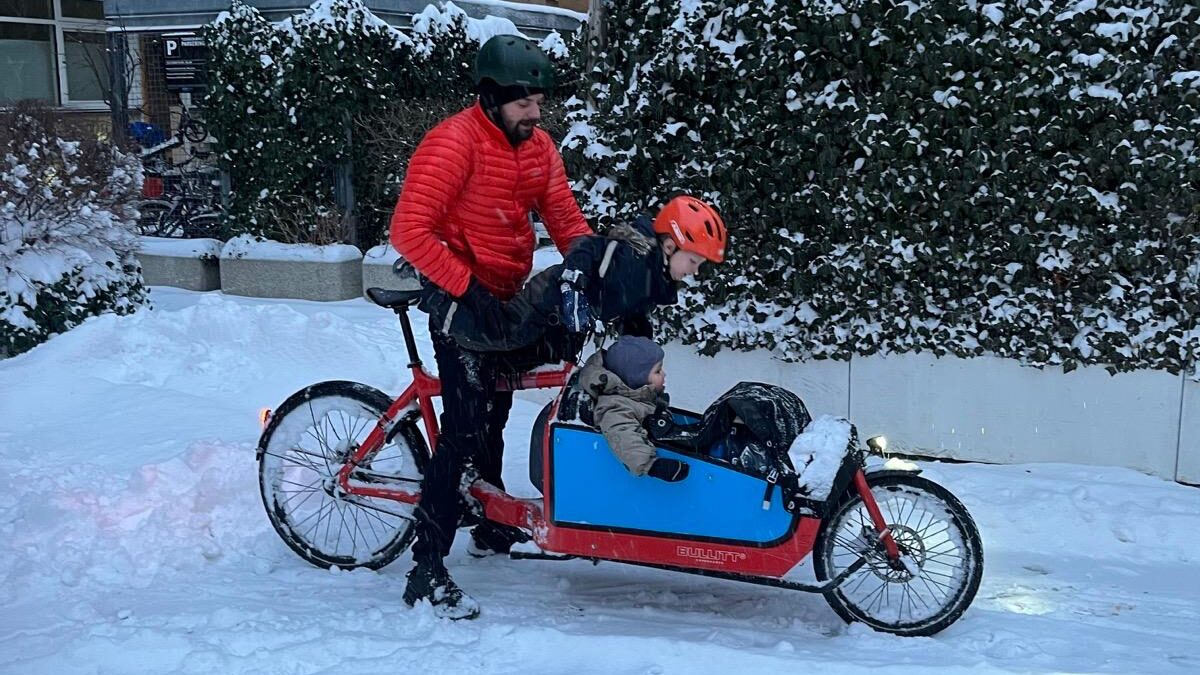
Most people shopping for an e-cargo bike start with the motor. It is the number on the poster, it is what the shop leads with, and it is the easiest spec in the whole catalogue to compare. 85 Nm beats 75 Nm. More is better. Done.
It is also the wrong place to start.
Not because motors do not matter. They matter a lot, and by the end of this you will know which one you want. But the motor is one part of a system, and the rest of that system decides how hard the motor has to work. Two bikes running the identical Bosch Cargo Line unit can feel like different vehicles, and the difference is not in the motor.
So before the torque figures, one distinction that explains most of what you will feel on a test ride.
Two kinds of e-cargo bike
There are two engineering lineages in this market, and almost nobody selling you a bike will name them.
Bike-first. The bike was designed to be ridden without a motor. The motor came later, as a version. Bullitt, Omnium, Muli and Christiania all still sell the unpowered original alongside the electric one. That is not nostalgia, it is the tell: the frame, the geometry and the gearing all had to work under leg power alone before any battery was bolted on.
Motor-first. The bike was designed around the drive unit from day one. Urban Arrow, Riese & Müller, Carqon, Ca Go and Gazelle have no unpowered version, because the bike does not really make sense as one. The motor is not an option, it is structural.
Neither is wrong. They are different products solving different problems, and the motor-first bikes are usually the more comfortable, better-integrated, more sofa-like thing to ride. The problem is that the difference is invisible on a spec sheet, and it is the single biggest predictor of whether the bike will feel the way you expect.
The weights make it concrete:
| Bike | Unpowered version? | Weight |
|---|---|---|
| Omnium Cargo V3 | yes | 20 kg |
| Bullitt, typical non-electric build | yes | ~22.7 kg |
| Bullitt eBullitt EP801 | — | 27.5 kg |
| Omnium E-Cargo V3 | — | ~28 kg |
| Tern GSD S00 | no | 35 kg |
| Riese & Müller Load5 60 touring | no | 35.5 kg (with battery) |
| Urban Arrow Family | no | 48 kg |
| Ca Go FS Vario | no | 53 kg (loading base and a second battery included) |
| Gazelle Makki Load | no | 54.5 kg (without battery) |
| Carqon Classic | no | 60 kg |
An electric Bullitt weighs less than an unpowered Urban Arrow would, if such a thing existed. An unpowered Omnium Cargo is a third of a Carqon Classic. That is the whole argument in two lines.
One caveat on that table: brands do not weigh their bikes the same way. Riese & Müller quotes the smallest frame with the battery in, Gazelle quotes without, Ca Go's figure includes a loading base and a second battery. Nobody includes a rain cover, and a canopy alone can be 8 kg. Treat these as a ranking, not as figures you can subtract from each other.
What follows from it: on a bike-first bike a flat battery is an inconvenience, and on a motor-first bike it is a recovery situation. You can legally and physically pedal a 48 kg bike home. You will not enjoy it, and you will not plan your week around the possibility.
What unpowered actually feels like
I ride a Bullitt without a motor, so treat the bike-first case above as an interested opinion rather than a neutral one. Here is the honest version of it.
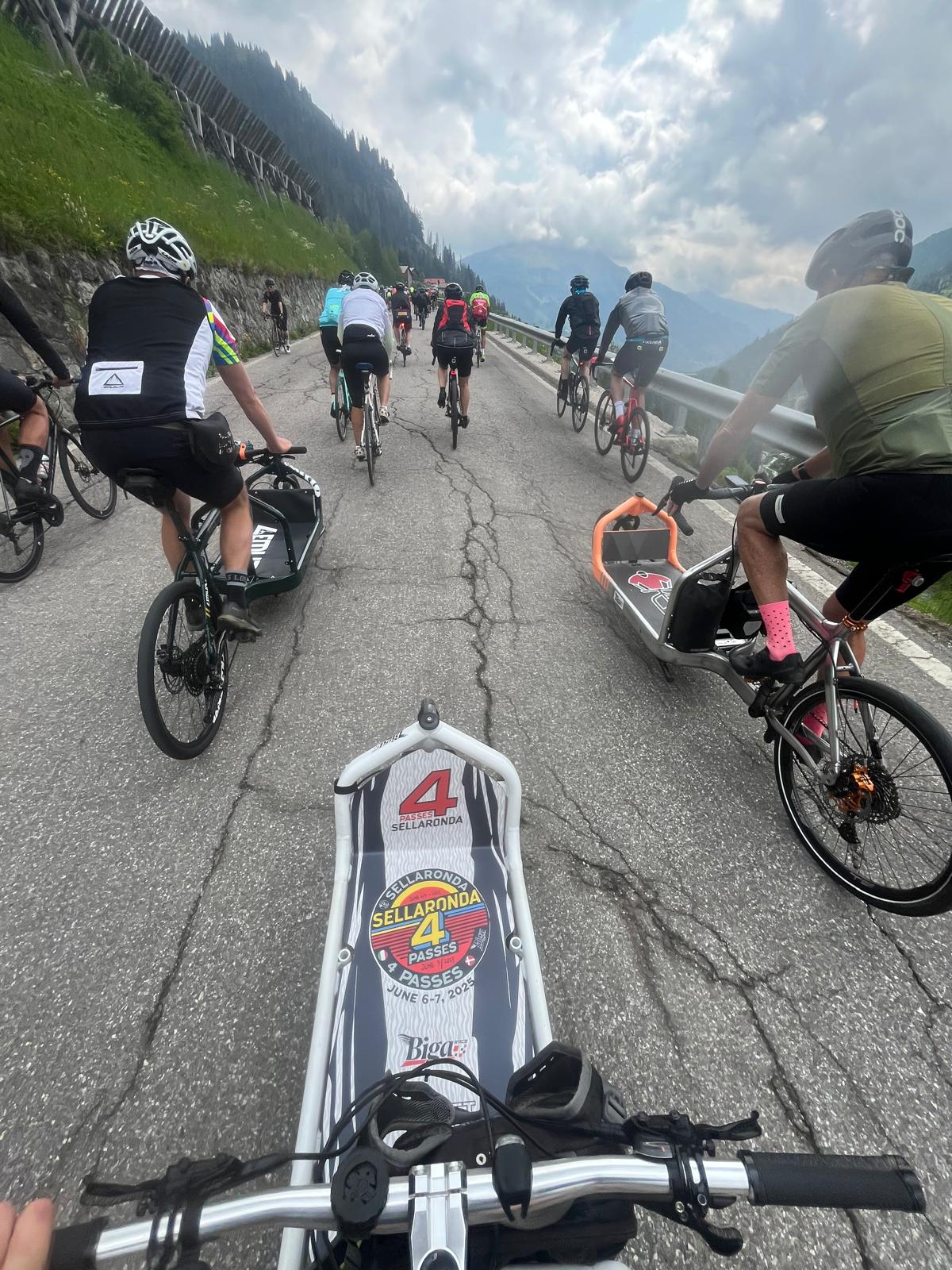
Four Sellaronda passes on an unpowered Bullitt. Not a typical Tuesday, and I am not claiming it is, but it does settle the question of whether legs are enough.
Getting up to speed takes a while. There is no hiding that. From a standstill with a load on the front you are moving a lot of mass with your legs alone, and every red light costs you. If your ride is stop-start through a busy centre, that is the part you will feel, and it is the best argument for a motor there is.
What surprised me is the other half. Once the bike is rolling, holding it at speed is not much harder than holding an ordinary bike at the same speed. At a steady pace most of what you are fighting is air, not weight, so the mass that made you slow off the line stops charging you for itself. A long john also carries its load low and between the wheels, so it tracks straight instead of asking for constant small corrections. Long flat stretches feel far easier than the first thirty seconds suggested they would.
So the unpowered version rewards a particular kind of ride: longer, flatter, fewer stops. It punishes the opposite, and it is worth being honest with yourself about which one your week actually looks like.
Then there is weather, which is where I will argue against my own bike. On a dry still day the effort is the good part. In a headwind it is work, and in cold rain it is work you can talk yourself out of at the front door. That is the real case for a motor and it has nothing to do with torque figures. The motor does not only move the bike, it removes the reasons not to go. If this bike has to replace a car on exactly the days you least feel like riding, buy the motor. A bike that gets ridden beats a bike that is lighter.
If you want the longer version of why this shape suits me, I wrote about that in why I ride a long john.
What the brands actually run
Almost the entire European market runs on two suppliers, Bosch and Shimano, and which one a bike uses lines up with its lineage more neatly than you would expect.
| Bike | Motor | Torque | Gearing |
|---|---|---|---|
| Bullitt eBullitt | Shimano STePS 6100 / EP600 / EP801 | 60 / 85 / 85 Nm | derailleur or internal hub, belt optional |
| Omnium E-Cargo V3 | Shimano STEPS EP8 | 85 Nm | derailleur or internal, belt optional |
| Muli Motor st | Shimano EP5 | 60 Nm | Nexus Inter-5E hub, Di2 |
| Muli Motor st pro | Shimano EP6 Cargo | 85 Nm | hub |
| Urban Arrow Family | Bosch Cargo Line (Performance and Active Line on cheaper trims) | 85 Nm | Enviolo hub |
| Riese & Müller Load5 60 | Bosch Cargo Line, or Pinion MGU E1.12 | 85 Nm | derailleur, Enviolo, Rohloff or Pinion 12-speed |
| Tern GSD S00 | Bosch Cargo Line | 85 Nm | Enviolo SP, Gates belt |
| Tern HSD | Bosch Performance Line | 75 Nm | — |
| Carqon Classic | Bosch Performance CX Cargo Line | 85 Nm | Enviolo stepless, or Shimano 10-speed |
| Ca Go FS Vario | Bosch Performance CX Cargo Line | 85 Nm | Enviolo AUTOMATIQ (shifts itself) |
| Gazelle Makki Load | Bosch Performance Line | 75 Nm | Enviolo Heavy Duty, Gates CDX belt |
Look at the right-hand column, not the middle one.
Most of the motor-first bikes have converged hard: Bosch Cargo Line, 85 Nm, Enviolo hub, often a belt. Pick any two and the drivetrain is close to identical. The bike-first bikes are mostly the ones still offering you a choice, including the choice of a smaller motor.
The exceptions are worth knowing. Riese & Müller offers more drivetrain variety than anyone here, two motor systems and four gearing options on one model, and Carqon will sell you a plain Shimano 10-speed instead of the stepless hub. So the pattern is real but it is not a law, and if what you want is choice, those are where to look.
Gearing is the half nobody mentions
Torque figures are cheap, and here is the cleanest proof of it. Pinion's motor-gearbox unit is quoted at 85 Nm like most of the others, but in its lowest four gears it puts up to 160 Nm into the rear wheel, because the gearbox multiplies it. Same motor, same headline number, roughly double the shove where you need it. The gearing decided that, not the motor.
What you actually notice on a loaded cargo bike is whether you can change gear at the moment you need to.
Picture a hill start at a junction with 50 kg of kids on board. You stopped in the wrong gear. On a derailleur you cannot fix that, because a derailleur needs the chain moving to shift, and you are stationary on a slope with a fully loaded bike. On an internal hub you can shift standing still, and then pull away. This single behaviour is why the heavy end of the market is almost entirely hub-geared, and it matters far more day to day than the difference between 75 and 85 Nm.
Some hubs now solve it for you outright. Ca Go fits the Enviolo AUTOMATIQ, which chooses the ratio itself, so being in the wrong gear stops being a thing you can do. Whether that is a relief or an annoyance is genuinely personal, and it is high on the list of things to find out by riding rather than reading.
There is a second, less obvious reason. Internally geared hubs have a maximum input torque, and it is a hard engineering limit. Enviolo's Utility hub is rated to 120 Nm, up from 100 Nm on its predecessors. A Rohloff Speedhub takes 130 Nm. Those ceilings sit above what any of these motors produce at the crank, but not by a huge margin once gearing multiplies it, and they are part of why the hub, the motor and the frame get specified as a package rather than mixed freely.
There is a third option now, and it is worth knowing about because it sidesteps the whole question. Pinion's MGU builds the motor and a 12-speed gearbox into one sealed unit at the bottom bracket, with a 600% range, which is wider than an Enviolo and comparable to a Rohloff. Nothing hangs off the back wheel, so there is no derailleur to smash on a kerb and no hub to rebuild. It is heavier and it is currently rare on cargo bikes, Riese & Müller being the notable one here, but if you have ridden a Bosch-and-Enviolo bike and wanted more range at the bottom, this is the thing to try.
This is also where the two lineages diverge again. A bike-first bike needs a gear range wide enough that a human can move it up a hill alone, because that was the original design brief. A motor-first bike can lean on the motor for the bottom of the range, which is a legitimate choice, right up until the battery is empty.
And a note on belts. A Gates carbon belt does not rust, does not need oil, does not mark your trousers, and lasts a long time. It also requires a frame with a splitter and it only works with hub gearing. If low maintenance is the priority, this is the combination to look for, and it is another reason the motor-first bikes cluster where they do.
What a bigger motor is really hiding
"I need more power" is usually a diagnosis, not a symptom, and it is often the wrong one.
When a cargo bike feels sluggish, the cause is frequently something the motor is being asked to compensate for:
- Mass. 48 kg before you load anything is 48 kg the motor moves every time you pull away.
- Frame flex. Long bikes with a heavy front load twist under hard acceleration. Energy that goes into bending the frame does not go into moving you forward.
- Steering geometry. A very slack front end is stable at walking pace and vague everywhere else. That vagueness reads as "slow", and a stronger motor does not fix it.
- Gearing you cannot use. If you are always in the wrong gear, the motor is covering for the drivetrain.
A bigger motor masks all four. It does not fix any of them, and it costs you battery range and, eventually, drivetrain wear to do the masking.
The flip side is the useful conclusion: a 60 Nm motor on a 28 kg bike can feel more eager than an 85 Nm motor on a 50 kg one. Which is exactly why Bullitt still sells the 60 Nm STePS 6100 as a serious option rather than an entry-level apology, and why plenty of people who ride one do not want more.
So what should you actually buy
A rough decision path, in the order the questions matter:
- How far, how hilly, how loaded? Flat city with two kids is not the same problem as a hilly commute with a trade load. Genuine hills and genuine weight are the case for 85 Nm. Flat and moderate is comfortably 60 to 75 Nm territory.
- Do you want a bike or a vehicle? If a dead battery must not ruin your day, and you want the thing to feel like a bicycle, you are shopping bike-first. If you want maximum comfort, integration and load capacity and you will keep it charged, motor-first is the better product.
- Hub, derailleur or gearbox. Loaded hill starts and low maintenance point to a hub. Lower cost, lighter weight and easier field repair point to a derailleur. Widest range and least to go wrong, at a weight and price premium, points to a Pinion gearbox.
- Then, and only then, the motor. By this point the shortlist has usually made the choice for you.
You cannot read this off a page
Everything above narrows the field. None of it tells you how a bike feels, and feel is the thing you are actually buying.
Cargo bikes differ more from each other than regular bikes do. The steering is unusual on all of them and unusual in a different way on each one. Some people step onto a long john and get it in thirty seconds, some people need a week. Some people love the sofa-like calm of a heavy front-loader and some people find it dead. There is no spec that predicts which of those you are.
So go and ride them. Ideally ride two on the same afternoon, because the comparison teaches you more than either bike alone, and take the hill you actually have to climb rather than the flat car park outside the shop.
The efficient way to do that is a multi-brand shop, where you can ride a bike-first and a motor-first bike back to back in the same hour instead of spending a weekend crossing town. We list those separately on every city page, and flag which shops do test rides.
If you are in or near one of these, the work is already done:
Berlin · Hamburg · Copenhagen · Amsterdam · Antwerp · London
Anywhere else, the full map covers shops across Europe, filterable by country and by brand, with an address search and a radius so you can see what is actually near you: find a shop near you →
If you are earlier in the process and still working out which type of bike you need at all, start here instead: new to cargo bikes →
And once you have the bike, the aftermarket is where it becomes yours. OpenCargo lists 398 parts and accessories from 54 independent makers across 13 countries: browse everything →
---
Motor specifications checked against manufacturer sources in August 2026. Drive units change with model year and vary by market, so treat this as a snapshot and check the manufacturer's configurator before you buy. If you spot something out of date, tell us and we will fix it.
Written by
Vincent
Founder, OpenCargo