Cargo bike battery locks: what fits, what it costs, and what to do when nothing fits your bike
August 10, 2026
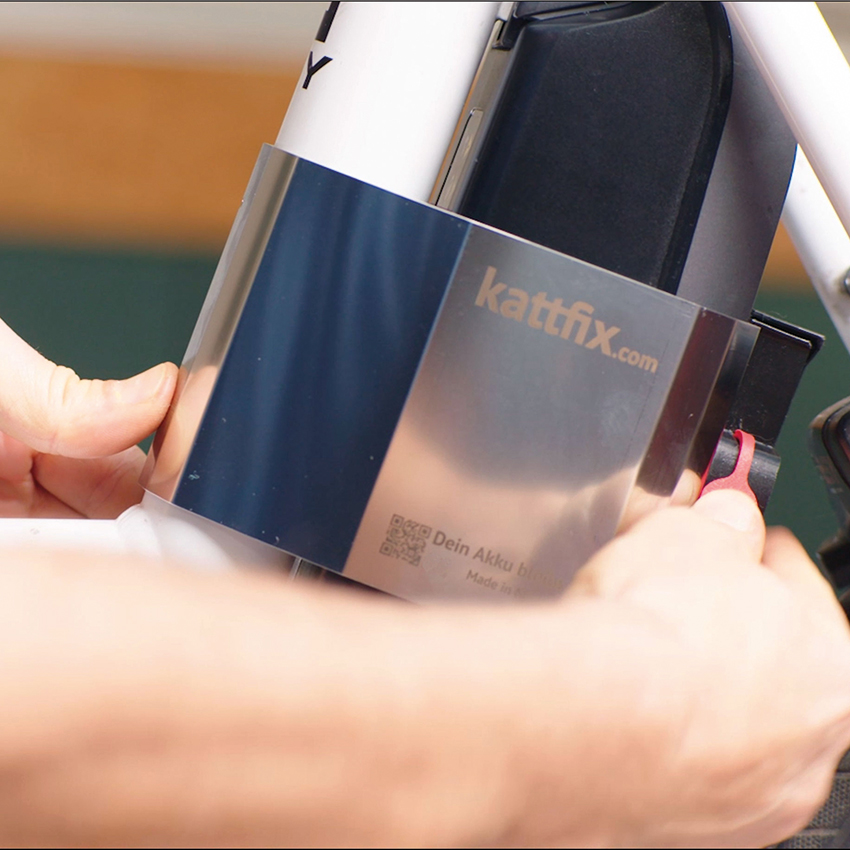
Everyone locks the frame. Almost nobody locks the battery.
That is strange when you look at what a thief is actually choosing between. The frame is heavy, awkward, has a number stamped on it, and takes time and noise to free from a rack. The battery is designed to come off in three seconds, weighs about as much as a bag of shopping, has no number anyone checks, and sells to the next person without a single question. One of those is a job. The other is picking something up.
I spent a while looking at what the catalogue actually holds here, because I wanted to know whether "get a battery lock" is real advice or the kind of thing people say. It is real advice, and it comes with a catch that nobody mentions: it depends entirely on which bike you own, and for about half the bikes on this site there is no off-the-shelf answer at all.
Here is the whole picture.
Why the battery and not the bike
A removable battery is a design decision that solves three problems. You can charge it indoors without wheeling a 50 kg bike into the hallway. You can take it out over winter. You can replace it in eight years without replacing the bike.
Every one of those is also a feature for the person stealing it.
The resale side is the part that makes it worse. A stolen frame is a marked object. Serial numbers are registered, marketplaces get watched, and a buyer who cares can check. A battery is a consumable that people buy secondhand for entirely innocent reasons, because packs age and a replacement from the brand is expensive. Nobody asks a secondhand battery where it came from, and there is no register to ask.
So the battery is the one part of the bike where the theft is low effort, low risk, and lands in a market that is already used to buying used ones.
What the lock that came with your bike is for
Most e-bikes ship with a barrel lock on the battery mount and a small key. It is easy to assume that is the security, and then wonder why anyone sells an aftermarket product.
Read what that lock is doing and it is clearer. It stops the pack falling out. That is a genuine and important job on a cargo bike, which spends its life going over kerbs with the pack cantilevered off a frame, and it is why the lock exists. Keeping the battery in the bike over a speed bump and keeping it there against someone who wants it are not the same engineering problem, and the part solving the first one was never asked to solve the second.
That is the gap the aftermarket fills, and it is worth being fair about it: this is not a case of makers cutting corners. It is a case of one part being asked to do a second job it was never specified for.
What an aftermarket battery lock actually is
Not a padlock through a loop. Both makers in the catalogue build the same basic thing, which is a hardened steel bracket shaped for one specific battery and one specific mount, bolting to the mounting points the battery already uses so the pack cannot be lifted off its rail.
The two go about it slightly differently.
Lockride is Dutch, and their brackets close with a separate ABUS padlock, a Diskus on some models and an Expedition on others. Their Original Battery Lock for Urban Arrow is a steel bracket that bolts around a Bosch PowerPack so it cannot be lifted off, padlock included, at 149.90 EUR.
Kattfix is German and builds a hardened stainless steel bracket that bolts to the battery's existing mounting points, securing the pack to the frame without drilling and without permanent modification. Their catalogue is priced almost flat at 199.90 EUR, whatever the bike.
That "without drilling, without permanent modification" line matters more than it sounds. It is the difference between an accessory and a modification, and it is what keeps the bike in the state your warranty assumes. Bolting to mounting points the battery already uses is not modifying the bike, and it is worth checking that any bracket you buy can say the same.
The part nobody tells you: fit is everything
A battery lock is not a size, it is a part number. It has to match your battery, your battery's connector generation, and how the pack sits on your bike. Lockride's Urban Arrow bracket comes in BES2 and BES3 versions for the two Bosch connector generations, and those are not interchangeable. Kattfix's Bullitt lock lists five separate variants, one each for the 418 Wh Shimano, 504 Wh Shimano, 545 Wh Bosch, 630 Wh Shimano and 800 Wh packs.
Which means the useful question is not "should I get a battery lock". It is "does one exist for my bike at all".
I checked. Across the 23 platforms on this site, stripping out one made-to-order product that is listed against everything, 11 have a battery lock made for them and 12 do not.
Platforms with a lock made for them
| Platform | Locks available | From |
|---|---|---|
| Riese & Müller | 4 (Load 60/75, Multicharger 2 750 Wh, Multitinker, Packster) | Kattfix |
| Tern | 4 (GSD, HSD, NBD and Quick Haul, plus a Bosch frame-mount) | Kattfix, Lockride |
| Urban Arrow | 3 (Family, FamilyNext, Shorty, Cargo, Tender) | Lockride, Kattfix |
| Carqon | 2 (500 Wh, X-Cross) | Lockride, Kattfix |
| Gazelle | 2 (Makki, Cabby C380) | Lockride, Kattfix |
| Bullitt | 1 (five battery variants) | Kattfix |
| Ca Go | 1 (CS) | Kattfix |
| i:SY | 1 (i:SY and i:SY Cargo) | Kattfix |
| Lovens | 1 (Defender) | Lockride |
| Muli | 1 | Kattfix |
| Velo de Ville | 1 (Loady) | Kattfix |
Platforms with nothing made for them
Aventon, Bicicapace, Black Iron Horse, Cargofactory, Christiania, Dolly, Douze, Ili Cycles, jhog, Omnium, Radkutsche, Yuba.
Two of those deserve an asterisk rather than a complaint. Omnium and Christiania both still sell the unpowered original alongside the electric version, so a good number of those bikes have no battery to lock. "No battery lock available" is only a gap if you actually have a battery, which is a distinction the spec sheet will not draw for you and the motor guide goes into properly.
The pattern in the covered half is not subtle either. The platforms with the most options are the big closed-ecosystem brands, because that is where the volume is and an aftermarket maker tools up for volume. If you ride something built by a smaller independent, you are in the tail, and the tail is where you have to do some work.
If your bike is in the second list
The instinct is to go looking for a lock for your bike. The better move is to stop thinking about the bike and start thinking about the battery.
Almost nobody makes their own pack. If your bike runs a Bosch PowerPack or a Shimano battery, and a great many do, then what a bracket has to fit is the pack and its rail, not the badge on the down tube. Both makers sell exactly that:
- Universal Battery Lock for Bosch PowerPacks, Kattfix, 199.90 EUR, listed for 400, 500, 545 and 800 Wh packs
- Universal Battery Lock for Shimano Batteries, Kattfix, 199.90 EUR
- E-Type Battery Lock, Lockride, 109.90 EUR, for rack-mounted Bosch PowerPacks, and it also covers Evo and Bafang rack systems
- Focus Battery Lock, Lockride, 154.90 EUR, for frame-mounted Bosch PowerPacks
So the honest version of the advice is: find out what pack you have and what generation of connector, then shop by that. Your bike not being on a maker's list does not mean the answer is no. It often means the answer is filed under Bosch.
Worth being straight about the limit here. Nobody guarantees these will clear your particular frame, and clearance is the thing that goes wrong. Measure, or ask the shop that services your bike before you order.
And if that fails, Kattfix will make one. Their made-to-measure service has you scan your bike to their instructions, they check the scan, and if they approve it they build a bracket for it and ship it about a week later, at 199 EUR. It is the same price as their catalogue parts, which is a more reasonable deal than I expected for a one-off, and it is the only route I found for a bike nobody has tooled for.
What it costs
The whole category runs from 109.90 EUR to 230 EUR. Lockride sit between 109.90 and 194.90, Kattfix between 199 and 230.
That is not nothing, and I am not going to pretend it is a small purchase. What makes the sum easy is what it is protecting: a replacement pack from the brand costs several times the lock, and you will be buying it at a moment you did not plan for, from the only supplier who has one. The lock is the cheaper half of that pair by a distance.
Where a battery lock stops helping
A battery lock solves exactly one problem, and it is worth naming the ones it leaves alone.
It does nothing about the bike. A cargo bike is a large expensive object parked in public and it needs a proper frame lock and somewhere solid to attach it, which is a different job with different gear and is covered in the lock and theft protection guide.
It does nothing about recovery. If the bike goes, a lock is not what gets it back. That is a tracker and a paper trail, and both are covered in the GPS tracker guide and in what to do when your cargo bike is stolen, which is the one to read before you need it rather than after.
And it does nothing about the ten seconds where the pack is in your hand and the bike is on the street. No bracket helps there. That one is habit.
The rest of what is available for this, brackets, frame lock holders and the mounts that keep a lock on the bike so it is always with you, is in security.
---
Sourcing. Every product, price and fit claim above comes from the OpenCargo catalogue as it stood on 11 August 2026: 31 live battery locks from two makers, Kattfix with 19 and Lockride with 12. Platform coverage was counted against the 23 platforms listed on this site, excluding Kattfix's made-to-measure service, which is listed against all of them because it is built per bike. Prices are the makers' own and will drift. We sell nothing here and earn nothing on these links, which go straight to the makers.
Written by
Vincent
Founder, OpenCargo